
In the first post in this two-part series, we started by thinking developing a research question and the methodology you might adopt to begin that investigation. In part two, we will look at the role of theory, data collection, analysis and formulating the conclusions of your research.
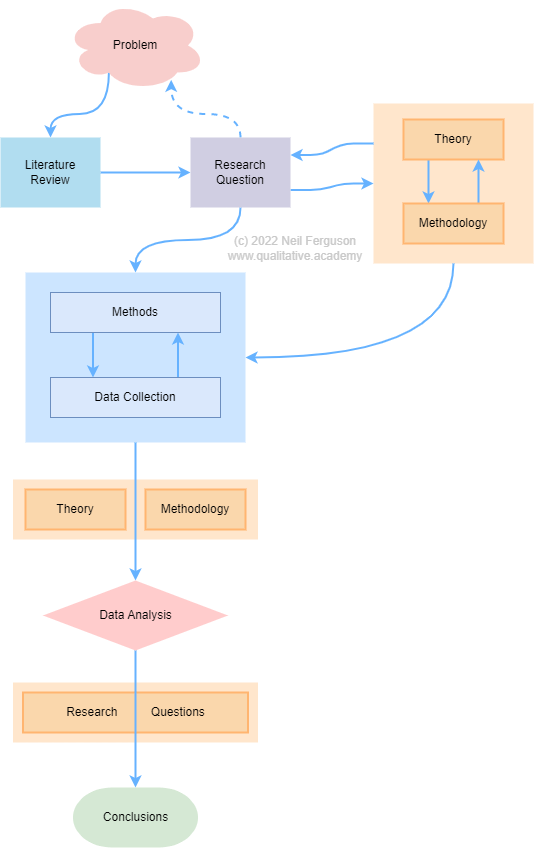
The full standardised research process is outlined in this image. It will open in a new tab so you can follow along and see where we are going.
Stage Three
This stage is reached after you have made the foundational decisions in stages one and two: you know your research question as well as the theory and methodology that will drive your project. Although you will likely have gleaned some ideas already from working on early stages, those decision will lead you to the methods best suited to obtain what you need to answer your research questions, essentially, what data you will need to collect.
Methods are the tools you will use to gather the data you need to answer your question. Now, while most methods are “methodologically agnostic,” different methodological approaches prefer some methods while tending away from others. Interviews, for example, are a common qualitative method. There are different styles of interviews preferred by different methodologies. If your study grounded in public documents released by an organisation, then interviews may be of little use to you.
Thinking about the sort of data you might need to answer your question is an important guide to choosing your methods. What guidance can you get from other people researching in your area? Read up on various methods, learning their strengths and weaknesses. Two common methods are discussed here.
With your method decisions made, you can go about applying those decisions. You can start reading your documents, conducting your interviews or focus groups, doing your content analysis, recording your videos, sending out a survey, whatever it might be.
Stage Four
To finally answer your research questions, you have to analyse the data. This might also be called the interpretive stage as what you are doing is looking at the data you have collected – the things people have said, facts and claims you have gleaned from documents, images you have analysed or recordings you have made – and trying to find the meanings that will answer you research questions.
We won’t go into the fine details of how to analyse your data, but you will end up with what we will call here themes that group together the individual pieces of data. It is in this process of analysis and interpreting that your models and theories – selected in stage two – really come into their own.
After have all your data, it is time to analyse it and you will do this through the lens of your theory. For example, your theory might be based on an author’s model that argues that a phenomenon goes through (say) a seven-step cycle. To what extent does your data match this cycle? Or you may be interested in the relationships between different departments in a large organisation and a model has suggested that the flow of information can be improved through a certain approach. You explore that by testing it and analysing the results.
Stage Five
The final stage is in the write-up: in what ways and to what extent have you answered your research questions? You will notice that the chart ends in conclusions going through research questions. Why is this? Why does the chart not finish with the research questions and their answers? There are at least two reasons. [1]
The first is that your conclusions go beyond answers to the questions: What are the implications of your findings? Are there policy suggestions you may want to offer? Any particularly surprising findings that need special highlighting? What about areas of further research? Questions like these are worth investigating around the answers to your research questions.
The second is that by the time you get to this stage of the process, you may find that the research questions you developed at the beginning were not quite the right ones for what you actually found in the research. Some suggest that a solution to this is to write the research question in the final document to line up with the conclusions you found. It is likely that you have already needed to modify the questions (and other aspects) already along the way. An alternate approach is to include the original questions in part or in whole to demonstrate the unexpected nature of your findings, the uniqueness of your data set, or maybe even to show the difficulties the area of research you are in faces or is likely to encounter.
Conclusion
In this series of posts, I have tried to show the common elements in a qualitative post-graduate research project, why they are there and, importantly, how each element interacts with the others.
A key message is that each part of a project serves its own purpose and also plays a role in the actions of other elements. A sound robust research project operates as a unity.
We are not talking about the conclusion chapter here. A conclusion chapter contains no new information but summarises the thesis and is your last chance to demonstrate the unique findings and importance of your research.